USDT vs  Wise vs
  Payoneer 2026: Cheapest USD for Filipinos
Hook
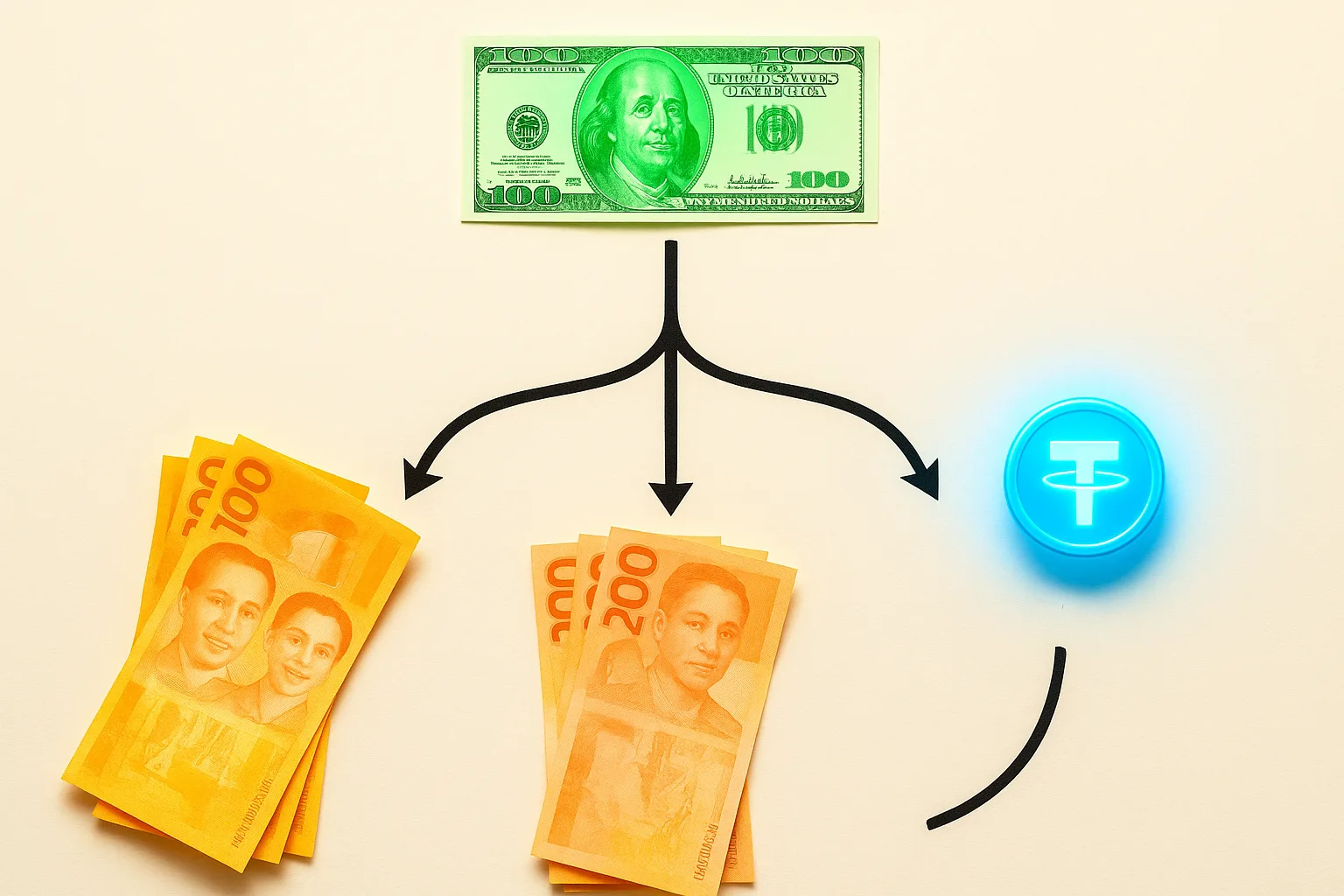
Filipino freelancers receiving USD income face three fundamentally different paths: traditional fintech (Wise, Payoneer), or crypto settlement via stablecoins like USDT. The choice you make costs — or saves — you thousands of pesos yearly in hidden fees.
Wise uses the mid-market exchange rate with a transparent percentage fee, typically $5–8 on a $1,000 USD→PHP transfer. Payoneer charges up to 3.5% FX spread over mid-market — that's roughly ₱1,700+ lost on every $1,000 converted (at illustrative ₱58:$1 rate — verify today's rate). USDT settlement is near-instant versus banking's 1–5 business days, but P2P off-ramp spreads in the Philippines run 1–3% in normal conditions, widening to 5% during volatility.
Most freelancers pick based on convenience (whichever marketplace integration is easiest) rather than cost. That's expensive. If you're earning $1,000–5,000 monthly, the wrong USD receiving path could cost you ₱20,000–100,000 annually in avoidable FX losses (illustrative range based on documented FX spread differentials), card fees, and P2P spreads. This comparison maps the real math, the regulatory realities (BSP, BIR treatment), and the documented trade-offs for each path.
Quick Answer
Use Wise if you invoice US/EU clients directly and they pay you via bank transfer. You'll save ~2-3% on every conversion versus Payoneer (on $1,000 USD, that's ₱1,200-1,800 per transfer). Wise gives you US bank details (ACH routing + account number) so clients pay you like a local vendor.
Use Payoneer if you earn through Upwork, Fiverr, Amazon, or other marketplace platforms. These platforms push payouts directly to Payoneer accounts for free—it's the path of least resistance. Converting to PHP costs more than Wise, but receiving is seamless.
Use USDT if your client already offers crypto payment and you're comfortable with counterparty and depeg risk. Settlement is same-day (often minutes), P2P spread to PHP is typically 1-3%, and no traditional banking middleman. Required disclosure: USDT carries regulatory uncertainty, no deposit insurance, and tax-reporting obligations under BIR rules.
At-a-glance comparison
| Feature | Wise | Payoneer | USDT (Tron/P2P) |
| Cost on $1,000 USD→PHP | $5-8 total (fixed fee + mid-market FX) | ~$35 (3.5% FX spread over mid-market) | $10-30 (1-3% P2P spread + <$1 network fee) |
| FX rate | Mid-market (Google rate) + transparent % fee | 3.5% markup over mid-market | P2P market rate (1-3% above mid-market in normal conditions; 3-5% during volatility) |
| Account fee | Free | Free account; $29.95/year for card | No account (self-custody wallet); exchange KYC required for PHP off-ramp |
| Settlement speed | Hours to 1-2 business days to PH banks/ | 1-3 business days to PH banks | Instant on-chain; P2P settlement minutes to hours depending on seller |
| Payout to PH banks | BPI, BDO, UnionBank, Metrobank | Binance P2P → GCash, bank transfer, or direct buyer arrangements | |
| Best for | Direct USD invoicing clients; clean FX; multi-currency holding | Marketplace payouts (Upwork, Fiverr integration) | Crypto-native clients; same-day settlement; capital preservation outside banking system |
| Regulatory status (PH) | BSP-registered remittance partner | Operates as international payment platform (not BSP-regulated payment instrument) | Gray zone — exchanges are BSP VASP-registered; USDT itself is unregulated in PH |
| Key risk | Account holds subject to verification delays | High FX spread; annual card fee even if unused | Depeg risk (2022 wobble to $0.96 documented); counterparty risk on Tether reserves; tax under-reporting common |
The principle behind the numbers: Wise optimizes for transparency (you see the exact FX rate and fee upfront). Payoneer optimizes for marketplace convenience (Upwork deposits land free, but you pay heavily when converting to PHP). USDT optimizes for speed and censorship-resistance (you control the asset, but the P2P spread and depeg risk are costs most freelancers underestimate).
For a Filipino freelancer earning $1,000 monthly, the FX difference alone between Wise and Payoneer is ₱1,500-1,800/month (~$27-32) at current exchange rates — that is ₱18,000-21,600/year in recoverable losses.
Wise Deep Dive
Wise is the transparency play in international payments—every fee, every exchange rate, every step shown upfront before you confirm. For Filipino freelancers receiving USD from US clients, it solves a fundamental problem: getting paid like a local vendor without the markup most remittance services bury in their FX spread.
How Wise Works for USD Receiving
Open a free Wise personal account, complete the ID verification (typically 1-2 business days), and you receive US bank details: an ACH routing number and account number. Your US clients pay you exactly as they would pay a domestic contractor—no wire transfer fees, no international payment forms, just a standard ACH transfer. The money lands in your Wise USD balance, where it sits until you decide to convert it to PHP.
This is the core mechanic: Wise gives you local receiving infrastructure in 9+ currencies (USD, EUR, GBP, AUD, and more) inside a single multi-currency account. You hold USD as USD, convert to PHP when the rate is favorable or when you need pesos, and send to your Philippine bank account (UnionBank, BPI, BDO, Metrobank) or directly to GCash. Transfers to the Philippines typically arrive within hours to 1-2 business days—often same-day during local banking hours.
The FX Pricing Model
Wise uses the mid-market exchange rate—the rate you see on Google or Reuters, with no markup. They then charge a transparent percentage fee on top, shown before you confirm the transfer. For a typical $1,000 USD→PHP conversion, the total fee runs around $5-8, depending on your funding method. That $1,000 becomes roughly ₱57,200 at a mid-market rate of ₱57.20 per dollar, minus the $5-8 fee—net ₱56,910 to ₱56,980 in your Philippine bank.
Compare this to a traditional bank wire, where the exchange rate markup alone eats 3-5% (₱1,700–₱2,850 on the same $1,000), and the math is clear. Most expensive feels cheaper when you see exactly what you're paying.
Funding method matters: bank debit or ACH is cheapest. Credit cards carry a 1.5-3% processor surcharge—on a $1,000 transfer, that's an extra $15-30, negating most of Wise's FX advantage. Use a bank account to fund transfers whenever possible.
The Wise Card and Cash Access
The Wise debit card costs roughly $9 one-time issuance fee in the US (free in many EU countries). It draws from your multi-currency balance, converting at the mid-market rate when you spend in a currency you don't hold. Two free ATM withdrawals per month up to $100 total; after that, roughly $1.50 per withdrawal plus 2% over the free limit.
For Filipino freelancers, the card is useful for online subscriptions billed in USD (Adobe, Notion, hosting) or international purchases—spending directly from your USD balance avoids double-conversion (USD→PHP→USD) if you were to use a Philippine credit card.
Philippine Payout Partners
Wise supports direct PHP transfers to all major Philippine banks: UnionBank, BPI, BDO, Metrobank. GCash direct deposit is also available. Arrival time during local business hours is typically minutes to a few hours; outside banking hours, expect next business day.
The routing: Wise holds PHP in safeguarding accounts with BSP-registered remittance partners in the Philippines. When you convert USD→PHP, Wise debits your USD balance, credits your PHP balance, and pushes the PHP to your nominated bank or GCash account. The BSP registration means Wise operates as a compliant remittance provider under Philippine regulations—this is not an offshore grey-market route.
Regulatory Status
Wise is fully regulated across jurisdictions: FinCEN MSB registration in the US, FCA-authorized e-money institution in the UK, and BSP-registered remittance partner in the Philippines. The company is publicly listed on the London Stock Exchange (ticker: WISE) since July 2021. This regulatory footprint matters for tax reporting: Wise provides transaction records you can use for BIR income declarations, and the paper trail is clean for audit purposes.
Documented Strategy for Filipino Freelancers
If you bill US clients directly (not through Upwork or Fiverr), give them your Wise USD ACH details. They pay you as if you were a US contractor—no $40 wire fees, no international payment hassle. You hold the USD in Wise, convert to PHP when you need pesos or when the exchange rate is favorable, and withdraw to your Philippine bank. On a $2,000 monthly freelance income, the savings versus a traditional bank wire run roughly ₱3,000-5,000 per month in avoided FX markups and wire fees—₱36,000-60,000 annually.
For US-based Filipinos (OFWs, dual residents): Wise USD ACH details work for receiving US payroll, Stripe payouts, and most ACH-based US transfers (verify with sender before relying on it). Converting USD→PHP via Wise is significantly cheaper than receiving a USD wire into a Philippine bank, where the receiving bank typically charges ₱500-1,000 plus a 2-4% FX spread.
The trade-off: Wise is optimized for small to mid-size transfers ($100–$50,000 range). Transfers above $50,000 may trigger additional verification delays, and the percentage fee structure makes it less attractive for very large one-time conversions compared to FX brokers who negotiate custom rates for high-net-worth clients.
Payoneer Deep Dive
Payoneer is the marketplace freelancer's default — if you work on Upwork, Fiverr, Amazon Mechanical Turk, or any of the 2,000+ platforms that pay via Payoneer's Mass Payout system, you're already using it or about to. The platform is designed for this exact workflow: client pays platform → platform pays you → you withdraw to your bank.
For Filipino freelancers, that means USD receiving accounts with US bank details (ACH routing + account number), EUR IBAN, GBP sort code, and seven other local receiving options. Your US client pays you like you're a domestic contractor; Payoneer handles the cross-border settlement behind the scenes. Account opening is free, online, and requires government-issued ID verification — expect 3-7 business days for approval, longer than GCash but faster than traditional bank USD accounts.
The Convenience Tax: FX Costs
Here's the problem: Payoneer charges up to 3.5% spread over the mid-market exchange rate when you convert currencies. That's not a transparent percentage fee like Wise — that's a markup inside the rate itself. On a $1,000 USD → PHP conversion, you're giving up approximately ₱1,925 (at ₱55/USD mid-market) compared to Wise's ~₱275–440 total cost.
Same-currency withdrawals (USD → USD bank account) cost around $1.50. Local-currency withdrawals (USD → PHP to your BPI/BDO/UnionBank account) cost approximately 2% of the withdrawn amount. For a ₱55,000 withdrawal, that's another ₱1,100 fee. Stack the FX spread and the withdrawal fee, and you're paying ₱3,025 total — versus Wise's all-in cost of under ₱500 for the same $1,000.
The math is brutal. Payoneer is not competing on price — it's competing on integration and speed.
The Card: $29.95 Annual Fee
The Payoneer Prepaid Mastercard costs $29.95 per year. You can use it for online purchases worldwide (your balance auto-converts at Payoneer's FX rate, which again carries that 3.5% spread), and for ATM withdrawals at approximately $3.15 per transaction. The card is useful if you travel or need a non-Philippine card for international subscriptions, but it's not a daily-driver card for most Filipinos — GCash Mastercard or Maya Visa are free and sufficient for local use.
If your Payoneer account sits idle for 12+ months with no activity, you'll pay a $29.95 inactivity fee. This matters for freelancers who shift from marketplace gigs to direct clients — if you stop using Fiverr and forget about your Payoneer balance, you'll bleed $30 annually.
The Documented Strategy for Filipino Freelancers
The documented workflow for Filipino freelancers earning $1,000–5,000 monthly from Upwork or Fiverr:
- Receive marketplace payouts into Payoneer (free; USD balance)
- Transfer Payoneer → Wise using Payoneer's bank-withdrawal feature (USD → Wise USD account details)
- Convert Wise USD → PHP at mid-market (₱275–440 fee on $1,000)
- Withdraw PHP to BPI/BDO/UnionBank or GCash (typically free or ₱15)
Total cost: ~₱300–500 versus Payoneer's direct USD → PHP conversion costing ₱3,000+. The extra transfer step saves you ₱2,500 per $1,000 — that's ₱30,000 annually on a $1,000/month income stream.
Why not skip Payoneer entirely? Because Upwork and Fiverr push payments to Payoneer by default. You can request direct bank transfer (wire), but that typically incurs a $30 wire fee per payout on the sender's side, and many clients refuse. Payoneer → Wise is the path of least resistance.
When Payoneer Wins
Payoneer is the right choice if:
- You earn primarily via marketplaces (Upwork, Fiverr, Amazon KDP, Airbnb) — it's already integrated, and receiving is free.
- You need to receive payments in multiple currencies without opening multiple bank accounts — Payoneer gives you local receiving details in USD, EUR, GBP, JPY, AUD, CAD, CNY, SGD, HKD.
- You bill international B2B clients who prefer to pay via Payoneer's invoice system rather than wire transfer.
Payoneer loses if you're receiving direct payments from US clients via ACH (use Wise's USD account details instead) or if you're converting large sums monthly (the FX spread alone will cost you more than most tools' annual fees).
For marketplace freelancers, the convenience is undeniable — but route your withdrawals through Wise, or you're paying a 5-6% total cost that no one earning under $5,000/month should tolerate.
The Reality Layer
Every tool in this comparison has a breaking point — a threshold where the math stops working in your favor, or a constraint that makes it the wrong choice. Here's where each option starts to cost you money or time you didn't budget for.
Hidden Costs
Wise looks transparent until you fund a transfer with a credit card or Apple Pay — processor surcharges of 1.5-3% wipe out most of the FX savings on smaller transfers. A $500 transfer funded via credit card costs you an extra $7.50-15 versus bank debit, which negates Wise's entire pricing advantage over remittance services. The Wise card takes 1-3 weeks to arrive in some countries, and high-value first-time transfers (typically above $5,000) trigger additional ID verification that can delay your payout by 2-5 business days while compliance reviews your documents.
Payoneer's FX spread is the silent killer. On a $1,000 USD→PHP conversion, Payoneer's 3.5% spread costs you ₱1,925 ($35 at ₱55/USD) versus Wise's ₱275-440 ($5-8). That's ₱1,485 lost per transaction — money that compounds every time you withdraw. The annual card fee of $29.95 (₱1,647) continues whether you use the card or not, and if your account sits inactive for 12 months, Payoneer charges another $29.95 inactivity fee. Some older Upwork plans layer on withdrawal fees of their own, which stack on top of Payoneer's conversion spread.
USDT's true cost is the P2P spread. On Binance P2P, USDT→PHP trades 1-3% above mid-market in normal conditions — that's ₱550-1,650 on a $1,000 off-ramp — and widens to 3-5% (₱1,650-2,750) during volatility. Ethereum gas fees can exceed $30 (₱1,650) during network congestion, making small ERC-20 USDT transfers uneconomic. Tax compliance carries a hidden cost too: BIR requires reporting crypto receipts as income at fair market value on receipt date, and most freelancers under-report, which creates audit risk down the line.
Lock-in Risks
Wise has minimal lock-in — your money moves freely to any bank account in any supported currency. The only friction is the 1-2 business day settlement time for ACH or SWIFT withdrawals.
Payoneer creates soft lock-in through marketplace integrations. Once Upwork or Fiverr pushes your earnings to Payoneer, extracting that money cheaply requires either spending on the Payoneer card or paying the 2% bank withdrawal fee plus the 3.5% FX spread. The documented workaround — Payoneer → Wise → PHP — adds a transfer step and 1-2 days of delay.
USDT creates the hardest lock-in. Once you hold USDT, converting to PHP requires KYC at an exchange or P2P platform. Anonymous receipt is possible, but you cannot off-ramp to PHP without identifying yourself. If US Treasury restricts USDT or BSP moves against Philippine VASPs, your exit route narrows overnight. Tether Ltd. can freeze addresses — documented cases exist where USDT was blacklisted at the smart-contract level, rendering it untradeable.
Who Should Avoid Each Option
Avoid Wise if:
- You're transferring above $50,000 regularly — compliance scrutiny increases, and you'll likely need to provide source-of-funds documentation
- You need cash deposits in the Philippines — Wise has limited physical cash pickup options compared to remittance services like
Western Union
Avoid Payoneer if:
- You invoice US clients directly (not via marketplaces) — Wise's USD ACH details are cheaper and faster
- You're converting small amounts frequently — the 3.5% FX spread becomes punitive below $500
- You won't use the card — the annual fee is wasted money
Avoid USDT if:
- You cannot tolerate depeg risk — the May 2022 wobble to $0.96 during the UST collapse is documented; USDT recovered, but there is no guarantee it will next time
- You're risk-averse on regulation — BSP does not regulate stablecoins as payment instruments, and US Treasury could move against Tether Ltd. at any time
- You're unwilling to report crypto income to BIR — tax evasion is not a strategy
- You're off-ramping below $200 — P2P spreads plus gas fees make small conversions uneconomic
The math changes based on your transfer size, frequency, and risk tolerance. Choose the tool that breaks least often under your actual workload.
Recommended Pick by Use Case
Direct US client invoicing: Wise wins decisively. A $1,000 invoice paid via ACH to your Wise USD account costs roughly $5-8 to convert to PHP, versus Payoneer's 3.5% FX spread that eats $35 of the same transfer. You save $27-30 per $1,000, which compounds to $324-360 annually on a $1,000/month income stream. The Wise debit card's $9 one-time fee pays for itself in the first month.
Upwork/Fiverr freelancer: Payoneer wins for convenience — marketplace payouts land directly in your Payoneer account with zero receiving fees, and Upwork's native integration makes withdrawal frictionless. But here's the move: receive in Payoneer, then transfer your balance to Wise quarterly before converting to PHP. Payoneer's direct USD→PHP conversion costs roughly 3.5% ($35 per $1,000), while moving USD from Payoneer to Wise (via their bank withdrawal feature, typically $1.50 fixed) and then Wise→PHP costs ~$7-8 total. You save $30-35 per $1,000 on the conversion leg — $120-140 saved per quarter for a freelancer clearing $4,000/month through marketplaces.
Crypto-native client paying USDT: USDT wins on speed — settlement is instant (Tron TRC-20 takes minutes, not 1-5 business days like ACH). Network fees are negligible (sub-$1 on Tron). The trade-off is the P2P spread: Binance P2P typically charges 1-3% above mid-market to off-ramp USDT→PHP, costing $10-30 per $1,000. That's comparable to Payoneer's FX loss but faster. The catch: you accept depeg risk (USDT briefly hit $0.96 in 2022), counterparty risk (Tether's reserves are attested but not fully audited by a Big Four firm), and regulatory uncertainty (BSP does not oversee USDT as a payment instrument). If your client base is already crypto-native and you're comfortable holding stablecoins, USDT works. If not, negotiate payment via Wise ACH instead.
Multiple payment streams (marketplace + direct clients): Use both Payoneer and Wise. Route marketplace payouts (Upwork, Fiverr) to Payoneer for zero-fee receiving. Route direct client invoices to Wise for cheaper FX. Move accumulated Payoneer balances to Wise quarterly to optimize the PHP conversion. You save ~$35 per $1,000 on each Payoneer balance you convert via Wise instead of Payoneer's direct withdrawal. For a freelancer earning $3,000/month split 50/50 between marketplace and direct clients, that's $210 saved annually on the Payoneer leg alone, plus another $162-180 saved on the direct-client leg versus using Payoneer for everything.
Solopreneur with steady $2,000/month USD income: Wise saves $120-180 annually on FX costs versus Payoneer (assuming all USD→PHP conversions). The Wise debit card's $9 one-time fee breaks even in the first month. At $24,000 annual income, the difference between Wise's ~0.5-0.8% total cost and Payoneer's 3.5% FX spread is $648-660 per year — money that stays in your business account instead of disappearing into spread markups.
Frequently Asked Questions
Is USDT safe, or could I lose my money if it "de-pegs"?
USDT is designed to maintain $1.00 USD, but the peg is not guaranteed by any government or insurance mechanism. During major market stress—most notably the May 2022 UST collapse—USDT briefly traded at ~$0.96 before recovering within days. Typical peg deviations in normal conditions are 0.5-2%.
The risk is counterparty: USDT is issued by Tether Operations Ltd., a private company. Reserves are attested quarterly by independent accounting firms, but Tether does not have a full audit by a Big Four firm as of 2026. If Tether's reserves are ever proven insufficient, USDT could collapse or trade permanently below $1.00.
For Filipino freelancers: if you hold USDT for more than a few hours between receiving payment and converting to PHP, you carry this risk. Wise and Payoneer, by contrast, are publicly listed companies (WISE on London Stock Exchange, PAYO on NASDAQ) with regulatory oversight. Your balance in Wise or Payoneer is not subject to peg risk, but you do face platform solvency risk (much lower given their public audits and regulatory capital requirements).
Practical guidance: If your client pays you in USDT, convert to PHP the same day via Binance P2P or your preferred exchange. Do not hold large balances in USDT overnight unless you are consciously choosing to take the depeg risk in exchange for faster settlement or lower fees.
How do I report USDT income for taxes in the Philippines?
The BIR treats crypto receipts as taxable income at fair market value on the date you receive them. If a US client pays you 1,000 USDT on March 15, 2026, and the USD/PHP rate that day is ₱58.50, you report ₱58,500 as income on your annual ITR.
If you later sell that USDT for ₱60,000 (because the PHP weakened), the ₱1,500 gain is treated as capital gains and taxed separately at 15% under current rules. If you sell for ₱57,000, you can declare a capital loss.
Most Filipino freelancers receiving crypto under-report or ignore this entirely, but the legal requirement is clear. Wise and Payoneer receipts are easier to document: both platforms provide transaction histories that align with your invoices, and the BIR expects you to report those as business income. USDT introduces complexity—you must track the PHP value on receipt date yourself, and exchanges do not automatically report your transactions to the BIR (though this may change as BSP tightens VASP oversight).
What this means for you: If you earn $1,000-5,000 monthly, the tax difference between USDT and Wise/Payoneer is negligible (same tax rate applies to all), but the documentation burden is higher for crypto. If you're risk-averse or want cleaner books for a future mortgage or business loan, Wise or Payoneer receipts are easier to defend in an audit.
Which is safest: Wise, Payoneer, or USDT?
Safety splits into three risks: platform solvency, regulatory shutdown, and user error.
Platform solvency: Wise and Payoneer are publicly traded, regulated financial institutions. Wise is FCA-authorized e-money in the UK, FinCEN-registered MSB in the US, and BSP-registered remittance partner in the Philippines. Payoneer holds similar licenses. Both are subject to quarterly audits and capital requirements. USDT is backed by Tether's reserves, which are attested but not audited by a Big Four firm—higher counterparty risk.
Regulatory shutdown: Wise and Payoneer operate within existing payment regulations. USDT sits in a gray zone: the BSP regulates VASPs (crypto exchanges) but does not directly regulate stablecoins. If the US Treasury or BSP moves to restrict USDT, your ability to off-ramp could disappear overnight. Binance P2P in the Philippines has been stable for years, but regulatory risk is non-zero.
User error: USDT allows you to send to the wrong address, choose the wrong chain, or fall for P2P scams—irreversible. Wise and Payoneer have customer support and dispute resolution. If you fat-finger a Wise transfer, you can often reverse it within minutes. Send USDT to the wrong wallet, and it's gone.
Verdict for Filipino freelancers earning $1,000-5,000 monthly: Wise is safest for most. Payoneer is safest if you're locked into marketplace payouts (Upwork/Fiverr). USDT is the least safe but compensates with speed and lower fees—appropriate if you understand the risks and need same-day settlement.
Can I use all three at once, or should I pick one?
You can and often should use all three, each for its optimal role:
- Wise for direct USD invoicing from US/EU clients who pay via ACH or wire. Lowest FX cost (₱5-8 on $1,000 vs. ₱35 on Payoneer). Use this as your default.
- Payoneer for marketplace payouts (Upwork, Fiverr, Amazon affiliate commissions). These platforms integrate directly with Payoneer, and switching to Wise requires manually withdrawing to a bank and then sending to Wise—adds friction and time. Keep the Payoneer account for this specific use case.
- USDT for clients who offer to pay in crypto or when you need same-day settlement (e.g., emergency cash flow, or a client in a sanctioned country where Wise/Payoneer won't work). Network fees on Tron are sub-$1, and Binance P2P settles to GCash within minutes during PH banking hours.
Documented strategy used by PH freelancers: Receive via Payoneer (marketplace), transfer Payoneer USD → Wise USD (free if both are USD accounts), then convert Wise USD → PHP at mid-market. This saves the 3.5% Payoneer FX spread. Takes 1-2 extra days but saves ₱35 per $1,000.
What this costs you in overhead: Three KYC processes, three dashboards to monitor, three tax reporting sources. For freelancers earning under $1,000/month, the complexity may not justify the savings—pick one and simplify. For $3,000+/month earners, the multi-tool strategy can save ₱5,000-10,000 annually.
How fast is each option, really?
Speed matters when you're managing cash flow or need to pay bills same-day.
USDT: Near-instant. Tron (TRC-20) and Solana settle in seconds to minutes. Ethereum (ERC-20) takes ~5-15 minutes depending on gas. Once USDT is in your exchange wallet, Binance P2P to GCash typically completes in 5-30 minutes during PH business hours (9am-6pm Manila time). Outside those hours, P2P liquidity thins and you may wait longer or pay a wider spread.
Wise: Transfers to Philippines typically arrive within hours to 1-2 business days. USD → PHP conversion via Wise Multi-Currency Account is instant (you hold PHP immediately), but withdrawal to a PH bank (BPI, BDO, UnionBank) or GCash takes 1-2 hours during banking hours, up to 24 hours if initiated after cutoff.
Payoneer: 1-3 business days for withdrawal to a Philippine bank. Same-day is not possible even if you initiate early. Payoneer → Wise transfers (if both accounts are in USD) take 1-2 business days.
Real-world implication: If you bill a client on Monday and need cash in your BPI account by Wednesday for rent, USDT is the only option that reliably hits that window if the client pays immediately. Wise hits it if the client pays Monday morning US time. Payoneer does not.
What this saves you: USDT's speed advantage is worth ~1-3% in P2P spread if you need emergency liquidity. For planned cash flow (monthly rent, quarterly BIR payment), Wise's 1-2 day window is fast enough and saves you that spread.
Your Action Step
Open a Wise account today if you receive USD from direct US clients — add it to your invoicing instructions and start receiving this week; the mid-market FX rate will save you $30+ per $1,000 transfer within the first month. Account opening is free, no setup fee required. Your US client pays to a US bank account (ACH routing details provided by Wise), you convert to PHP at mid-market when you need it, and withdraw to BPI, BDO, UnionBank, or GCash within hours. The math is simple: $5–8 transfer cost on Wise versus $35+ FX spread on Payoneer for the same $1,000.
If you already use Payoneer for marketplace payouts (Upwork, Fiverr), keep it for receiving but add a Wise account and move balances quarterly — the FX savings compound to $360+ annually on $2,000/month income. You receive in Payoneer (free from the marketplace), transfer Payoneer → Wise quarterly (absorb the one-time $1.50 same-currency withdrawal fee), then convert to PHP on Wise at mid-market. The FX arbitrage pays for the extra step within the first transfer.
Final Word
Match the tool to your actual income source. If you're receiving USD directly from US clients or via bank transfers, Wise wins on cost — roughly ₱300–400 saved per $1,000 versus Payoneer's 3.5% FX spread. If you're on Upwork or Fiverr, Payoneer wins on convenience — it's the platform default and receiving is free. If your clients pay in crypto, USDT wins on speed (settlement in minutes), but you're taking on depeg risk, regulatory uncertainty, and a 1-3% P2P spread to convert to PHP. Don't chase the shiny thing — use what saves you money for your specific situation.
Disclosure: This article includes affiliate links. We earn a small commission if you sign up via our links, at no extra cost to you. We only recommend tools we'd cover in this publication. Individual results vary. Income figures cited are illustrative based on documented public sources. This is not financial or investment advice. Verify current pricing and regulations on each tool's official website before making decisions.